
Loading…
A CRO program scored on what a lead was worth, not just how many came in


The brand
The Shade Store had built a premium custom window-treatment business around a hybrid model: rich digital exploration paired with high-touch in-home or virtual consultation. The buying journey stretched across days, devices, and channels: research online, request a consultation, visit a showroom, order swatches, schedule a measurement. The website's job was not to close the sale. It was to start the right conversation with the right shopper.
When Surefoot took over the program, every experiment had one constraint. It needed to answer a question about what each lead was worth, not just how many leads came in.
The impact
Lead-gen CRO and ecommerce CRO used the same testing tools, but they weren't the same problem. With The Shade Store, every experiment got scored against the kind of leads that actually drove business, not just total form submissions. That changed which tests we ran and which winners we shipped.




The challenge
Consultations, measurements, swatches, showroom appointments, quotes: the website generated several lead types and none carried the same weight. Optimizing for total form submissions risked shifting the mix in the wrong direction.
Research, consultation, showroom visit, measurement, install. Decisions stretched across days and devices, and a lot of the buying happened off-site. Tests had to respect a journey the website only saw part of.
Custom configuration was the product, but the breadth of fabrics, opacities, and hardware overwhelmed first-time shoppers exploring the catalog.
The website rendered separate mobile and desktop layouts via device detection, and the customizer's UX and code were intricate. Implementation friction was real and had to be planned for in every test.
The approach
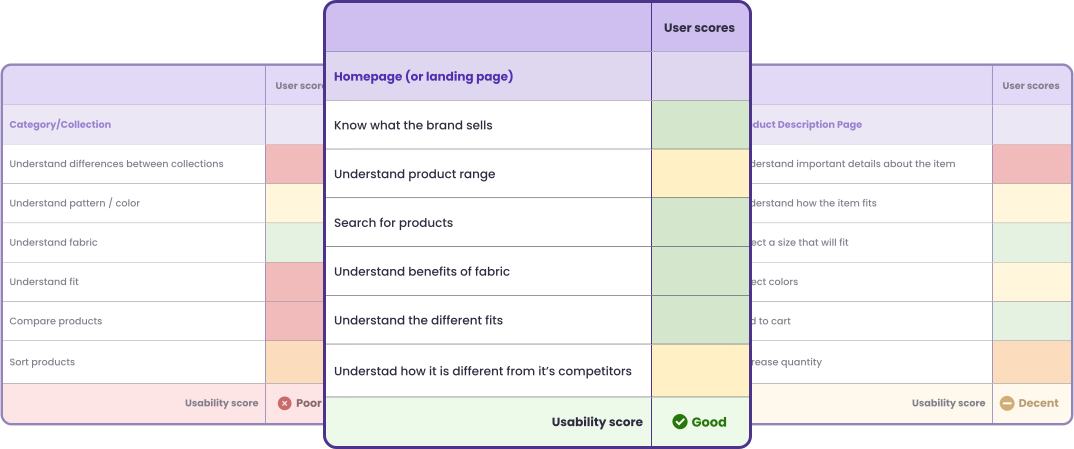
A 17-interview usability scorecard (10 consumers, 7 trade pros) plus persona work mapped where shoppers stumbled on mobile and desktop, and what motivated novice versus seasoned buyers. That research became the source of the roadmap, not opinions.
Every experiment got scored on what happened to the mix of leads, not just the total. Some of the program's biggest wins were tests where total submissions barely moved but high-value lead types went up.
When a test started harming a high-value lead type, the program called it early and treated the prevented loss as part of the result. A swatch nav test was stopped after it dropped most-popular-swatch orders by roughly 82%.
Findings from one test funded the next: shd-11's mobile nav learnings (more nav engagement, +21.4% nav taps) became shd-21's mobile nav overhaul, a winner that lifted measure requests without harming overall lead CR.

What we learned
Optimizing for total form submissions alone would have called this program's biggest wins flat. Scoring against what each lead was worth was what made them visible.
In-home consultations, measurement requests, swatches, and showroom appointments all lived on the same site, but they didn't carry the same weight in the business. Treating them as one number was the easiest way to ship the wrong winner.
When total submissions barely moved but the mix of lead types shifted toward higher-value ones, the experiment was doing real work. The aggregate hid it.

The results
The strongest experiments in the program shared a counterintuitive shape. Total form submissions barely changed. The mix of leads shifted toward higher-value types: in-home consultations, design appointments, measurement requests, the leads that actually started business. A program scored on form counts alone would have called those tests flat. A program scored on lead value called them what they were. A second discipline ran alongside the wins. Tests that started to harm a high-value lead type were stopped before they went live, and the prevented loss was treated as part of the result, not a footnote.
The takeaway
The right question for The Shade Store wasn't how many leads. It was which leads, and what they were worth.
Frequently asked
A lead-generation site supporting a long, considered buying journey. Total form volume mattered less than which lead types were growing and which were shrinking. The program needed to be designed around that distinction from the start.
Lead-generation conversion rate optimization, A/B testing, and user research. The program ran in Convert with Hotjar for session recordings and GA4 for analytics.
For brands with a considered purchase and several lead types of different value, the earliest gains landed in lead quality, not lead volume. The right headline metric was the mix, not the total.

Sports & Recreation
Building a conversion program that respects what shoppers already know.
Read case study
Beauty & Wellness
Their redesign was ready. We helped them know it would land before they pushed it live.
Read case study
Outdoor & Travel Gear
A clean pre/post test let Peak Design swap free US shipping for a $99 threshold, lifting AOV 17% and cutting annual shipping costs without a hit to net revenue.
Read case study